Radha Krishna
The Divine Tale of Eternal Love
Journey through devotion, joy, and divine union
Birth of Krishna
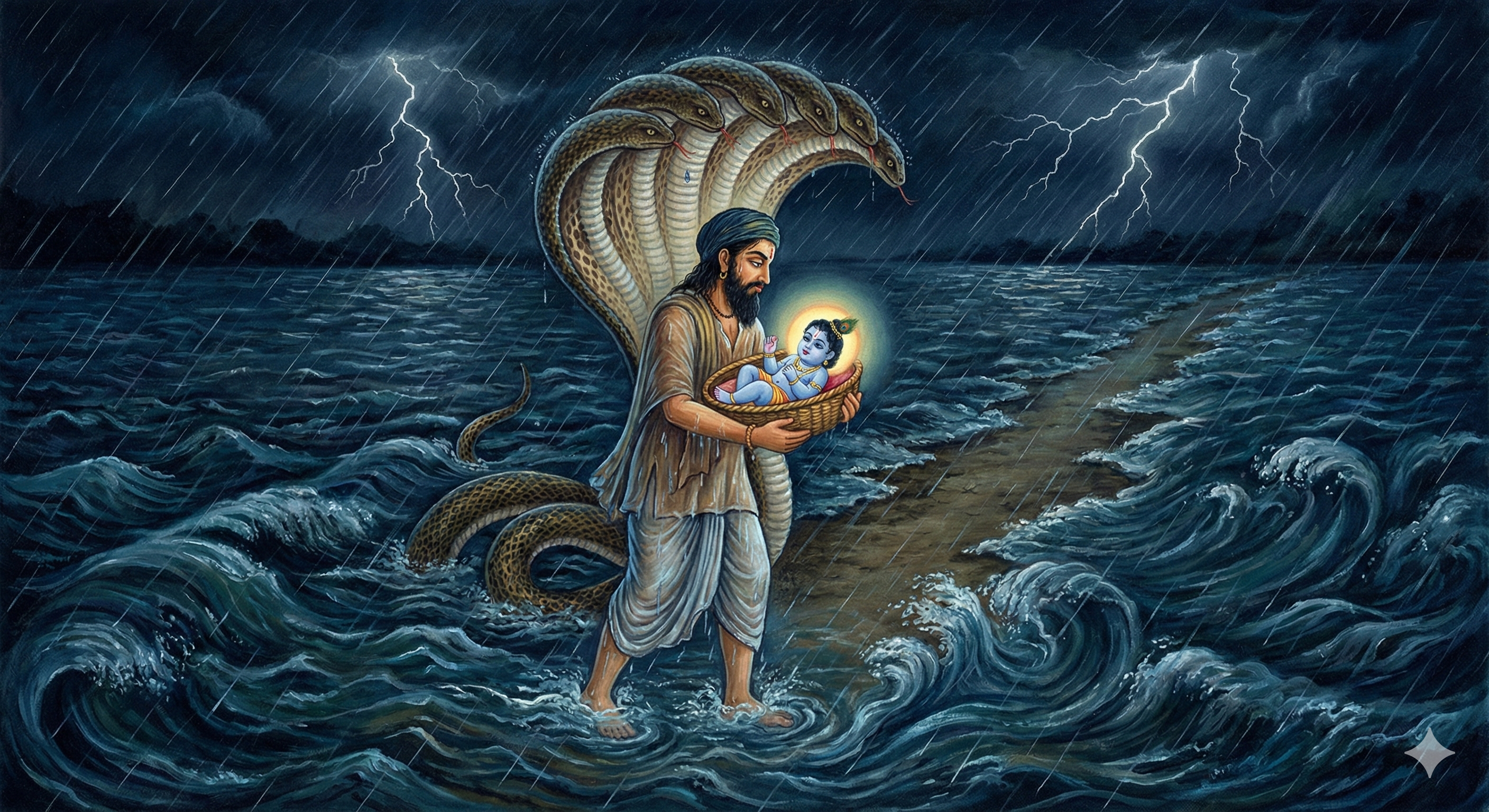
On a stormy, dark night in Mathura, Lord Krishna was born in a prison cell to Devaki and Vasudeva. The cruel King Kansa had vowed to kill Devaki's eighth child, but divine will intervened. Miraculously, the prison gates opened, and the guards fell into a deep sleep, allowing Vasudeva to carry the divine baby to safety. Braving the raging Yamuna river, which parted to give him way, Vasudeva took Krishna to Gokul. There, he was left in the care of Nanda Baba and Mother Yashoda, safe from Kansa's tyranny.
Fun Fact
Krishna was born at midnight on the eighth day (Ashtami) of the dark fortnight, celebrated globally as Janmashtami.

Childhood in Gokul
Krishna's childhood in Gokul was filled with divine plays (Leelas) that enchanted everyone. He grew up amidst the lush forests, grazing cows and playing with his cowherd friends (Gopas). Even as a toddler, he displayed immense strength and wisdom, winning the hearts of all the villagers. His infectious laughter and charming pranks brought unparalleled joy to Gokul, making everyone forget their worries. He was the apple of Mother Yashoda's eye, who witnessed the entire universe in his mouth but was bound by his love.
Fun Fact
Even the demons sent by Kansa, like Putana, could not harm him; instead, they attained liberation by his touch.

Krishna the Butter Thief
Krishna had an irresistible love for fresh butter. He would form human pyramids with his friends to reach hanging pots of butter in neighbors' homes. When the Gopis caught him, he would look at them with such innocent eyes that their anger would vanish instantly. Sometimes he would feed the stolen butter to monkeys! This playful act earned him the endearing title 'Makhan Chor'. It wasn't just theft; it was a way to steal the hearts of the devotees and teach that God hungers for our love.
Fun Fact
Krishna is known as 'Makhan Chor' not because he needed food, but because he loved the affection with which the Gopis churned the butter.

Meeting Radha
In the sacred groves of Vrindavan, Krishna met Radha, the daughter of Vrishabhanu. Their meeting was not ordinary; it was the reunion of the supreme soul with its divine energy. From their first glance, a bond deeper than the ocean was recognized. They played together, laughed together, and explored the forests of Braj. Their relationship established the highest form of love—spiritual, selfless, and pure—setting an example for eternity.
Fun Fact
Radha is known as 'Raseshwari', the queen of the Raas dance, and 'Hladini Shakti', the pleasure-potency of God.
Flute of Love
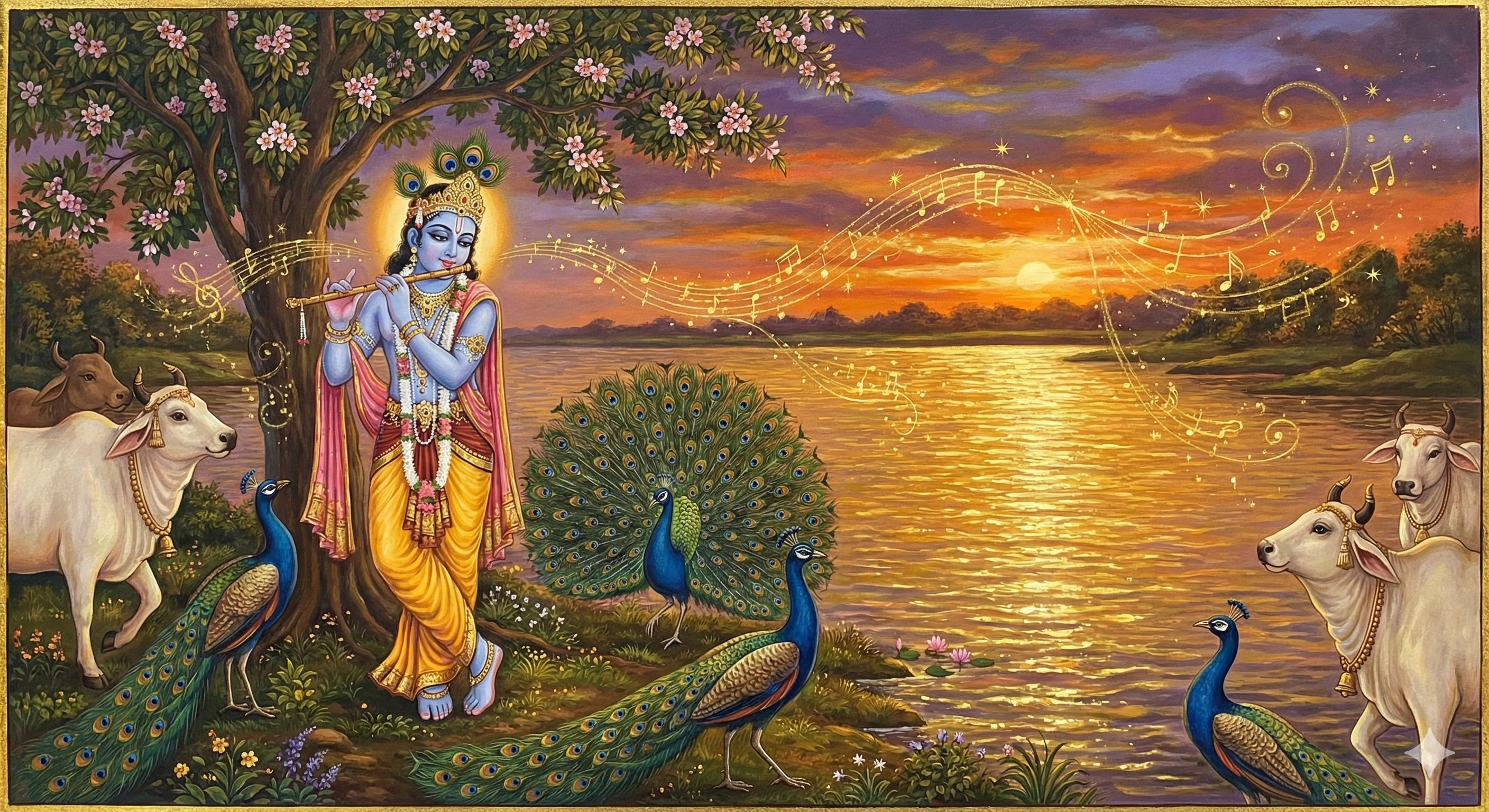
When Krishna played his flute (Bansuri) in the moonlit forests of Vrindavan, the entire world would stand still. The melody was so enchanting that peacocks danced, rivers slowed down to listen, and the Gopis left their household chores to run to him. It was a call of the divine to the human soul. The music communicated what words could not—infinite love and eternal bliss. Every note was a message of love addressed directly to Radha's heart.
Fun Fact
Krishna's flute is named 'Murali'. It is hollow, representing a heart empty of ego, ready to be filled with divine breath.

Raas Leela
In the magical autumn nights, Krishna performed the 'Maha Raas' on the banks of the Yamuna. Multipling himself into many forms, he danced with every Gopi simultaneously, making each feel he was with her alone. Radha stood at the center as the crowning jewel. This cosmic dance symbolized the highest state of devotion where the soul unites with God in pure bliss. It wasn't physical attraction, but the dance of spiritual liberation and divine joy.
Fun Fact
The Raas Leela is described in the Bhagavata Purana as the 'Dance of Divine Love' where one night stretched for the duration of a Kalpa (billions of years).
Krishna Lifts Govardhan
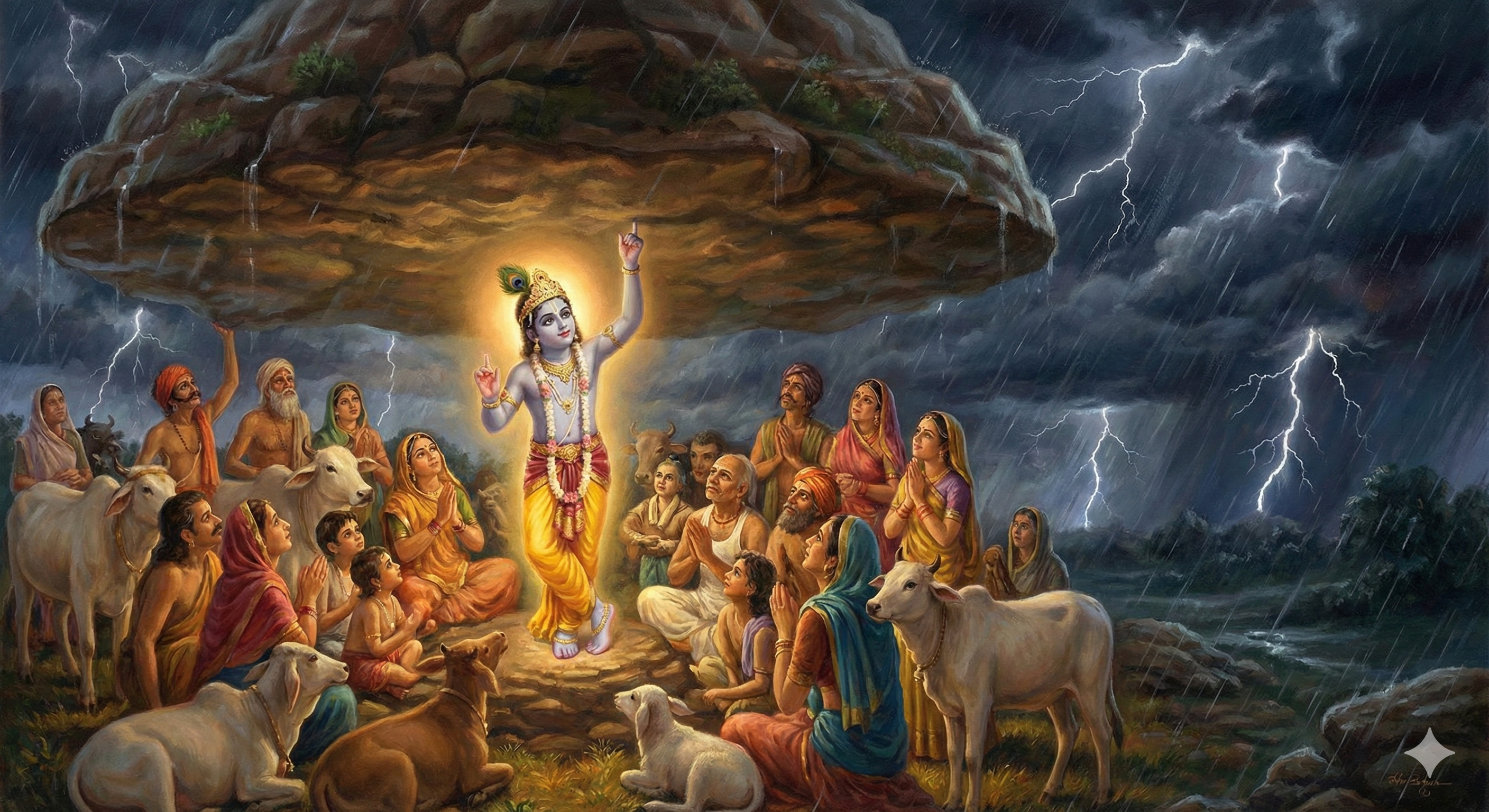
When the people of Braj prepared to worship Indra, the god of rain, Krishna convinced them to worship Govardhan Hill instead, as it provided fodder for their cows. Angered by this, Indra unleashed a devastating storm with torrential rain to drown Vrindavan. To protect his people and animals, the seven-year-old Krishna lifted the massive Govardhan Hill on the little finger of his left hand! He held it like a giant umbrella for seven days and nights until Indra realized his mistake and surrendered.
Fun Fact
Since then, Krishna is known as 'Giridhari' (The Lifter of the Mountain), and Govardhan Puja acts as a reminder that nature is divine.
Defeating Kaliya
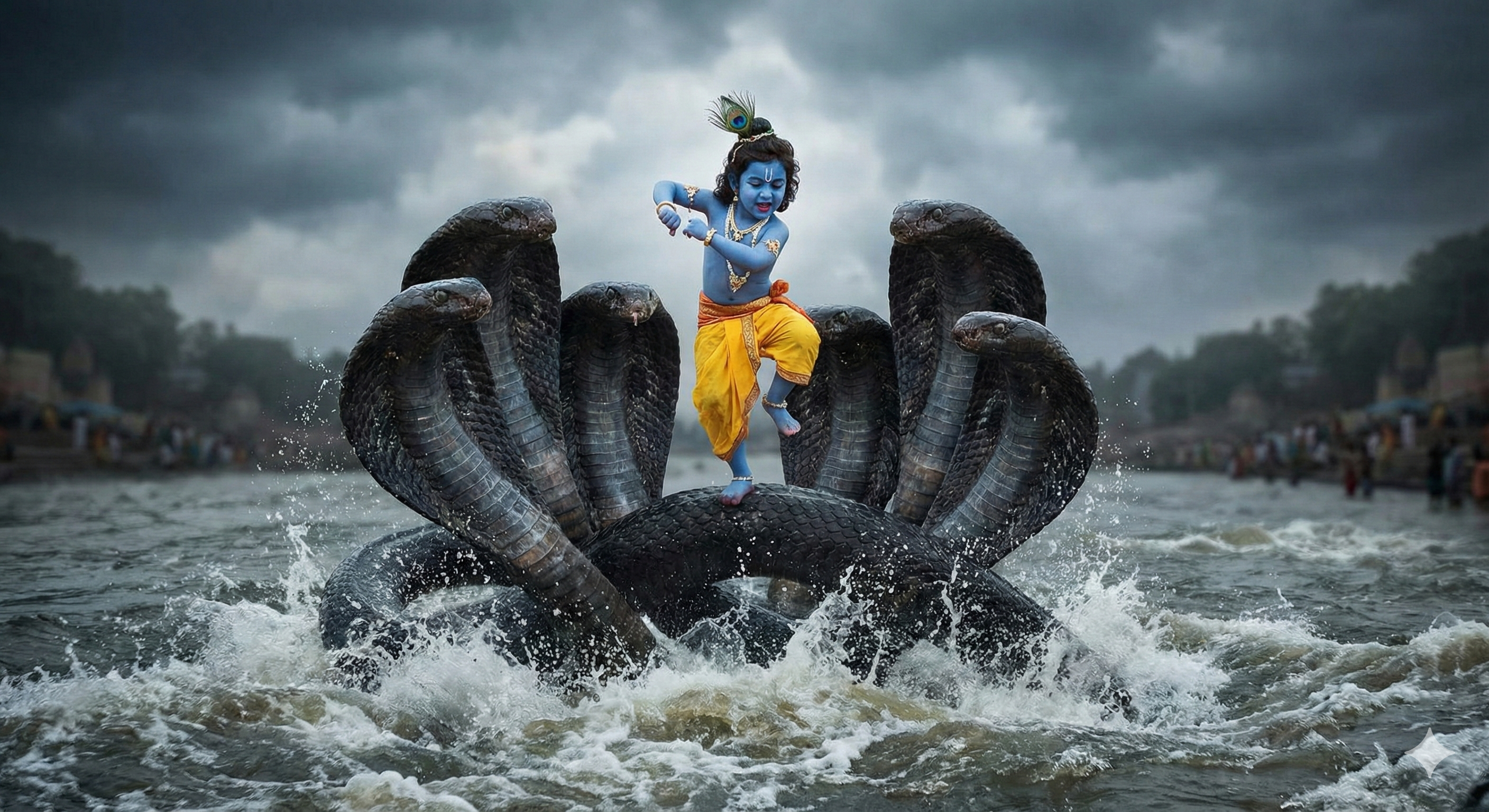
A giant, venomous multi-headed snake named Kaliya had poisoned the waters of the Yamuna river, killing birds and trees nearby. While playing ball with his friends, Krishna climbed a Kadamba tree and jumped into the river to tackle the serpent. Kaliya attacked him, wrapping his coils around the boy. But Krishna freed himself and danced upon the many hoods of the serpent! The weight of the Lord was unbearable for Kaliya. Finally, Kaliya's wives prayed for mercy, and Krishna banished the snake to the ocean, making the Yamuna pure again.
Fun Fact
The footprints of Krishna on Kaliya's head acted as a mark of protection against Garuda, the eagle enemy of snakes.

Love of Radha
Radha's love was never bound by marriage or societal expectations; it was a pure soul-to-soul connection. She loved Krishna not as a god, but as her everything. When Krishna was near, she was happy; when he was far, her thoughts were constantly with him. This state of 'Mahabhava' is unparalleled in spiritual history. She taught the world that the essence of love is sacrifice and selfless devotion, seeking nothing but the Beloved's happiness.
Fun Fact
It is said that Krishna enchants the world, but Radha enchants even Krishna. That is why she is the supreme goddess.

Farewell from Vrindavan
The time came for Krishna to fulfill his destiny and kill Kansa. Akrura came with a chariot to take him to Mathura. The moment was heart-wrenching. The Gopis wept, obstructing the chariot's path, and Radha stood silent, her eyes speaking volumes of pain. Krishna promised to return, but destiny had other plans. He left his flute and his peacock feather with Radha, symbolizing that he was leaving his 'soul' in Vrindavan while his body went to do its duty. This separation, or 'Viraha', is considered the highest form of devotion.
Fun Fact
Krishna never played the flute again after leaving Vrindavan, signifying that his sweet music belonged only to Radha and the Gopis.
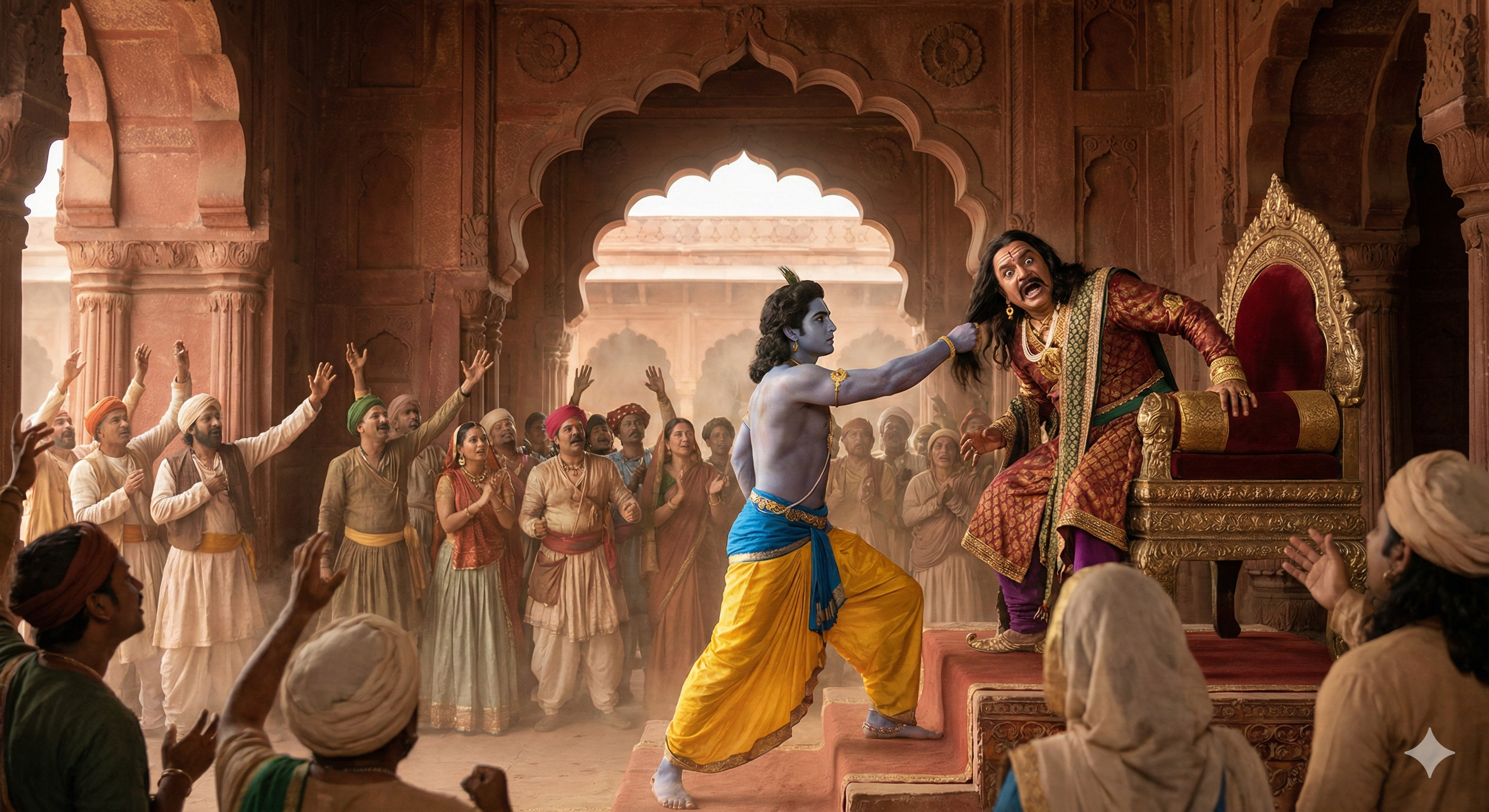
Krishna Defeats Kansa
Arriving in Mathura, Krishna and Balarama defeated the mighty wrestlers Chanura and Mushtika at the royal arena. Finally, Krishna faced his tyrannical uncle, King Kansa. Kansa, who had lived in fear of this moment for years, was dragged from his throne. With a single mighty blow, Krishna ended Kansa's reign of terror, liberating his parents Devaki and Vasudeva from prison and reinstating his grandfather Ugrasena as the King. The prophecy was fulfilled, and righteousness was restored in Mathura.
Fun Fact
Kansa attained liberation (moksha) because he thought of Krishna constantly, even if it was out of fear (Vaira-Bhakti).
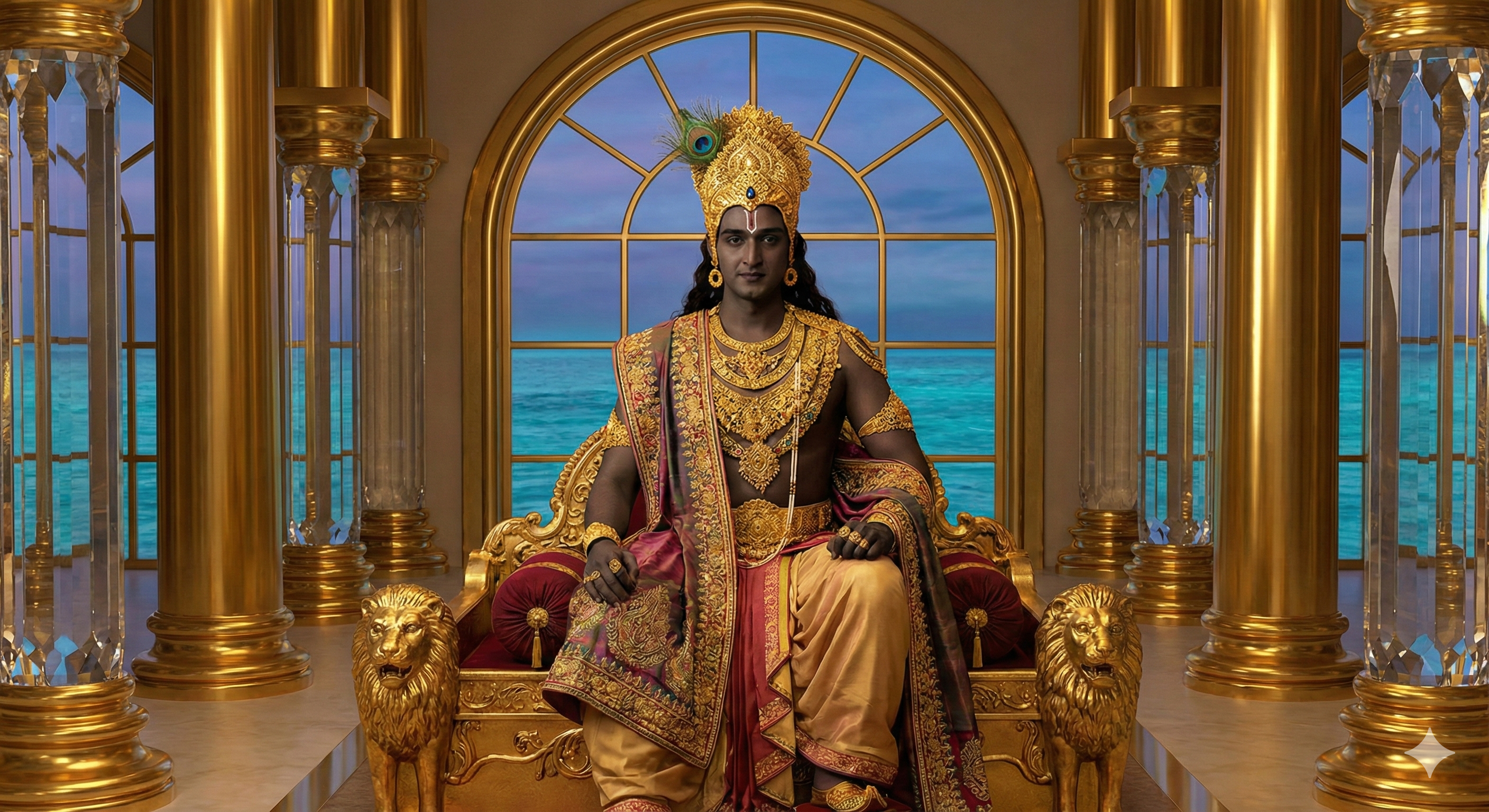
Krishna the King
To protect his people from the relentless attacks of Jarasandha, Krishna moved his entire kingdom from Mathura to a new island city called Dwarka, built in the sea by the divine architect Vishwakarma. Known as Dwarkadhish, Lord Krishna ruled as a wise and just king. Dwarka was a city of gold, filled with opulence and prosperity. Here, Krishna married Rukmini and Satyabhama, among others, and lived a life of royal duty, yet remaining detached and divine in his wisdom.
Fun Fact
Dwarka is believed to have submerged under the ocean after Krishna left the earth, and underwater ruins have been found by archaeologists.
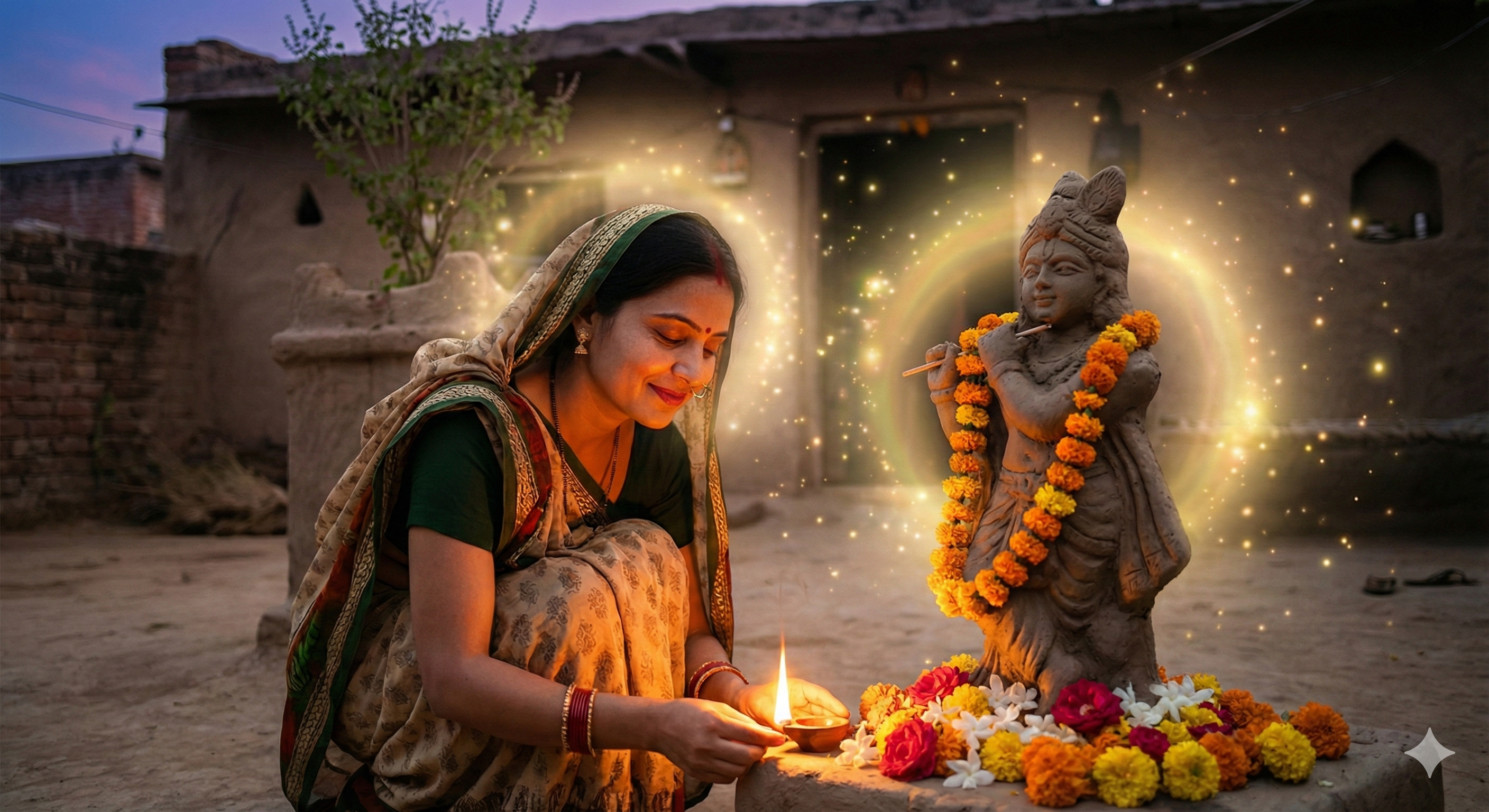
Radha’s Devotion
Back in Vrindavan, Radha lived with the memories of Krishna. She didn't dwell in sorrow but transformed her pain into power. She realized that Krishna was not just a person but a presence within her heart. Every moment of her life became a meditation on him. She served people, saw Krishna in every being, and became the embodiment of Bhakti. Her love was so intense that Krishna, even in his royal palace in Dwarka, could feel her emotions.
Fun Fact
Though they never married geographically, Radha and Krishna are eternally married in the spiritual realm of Goloka.
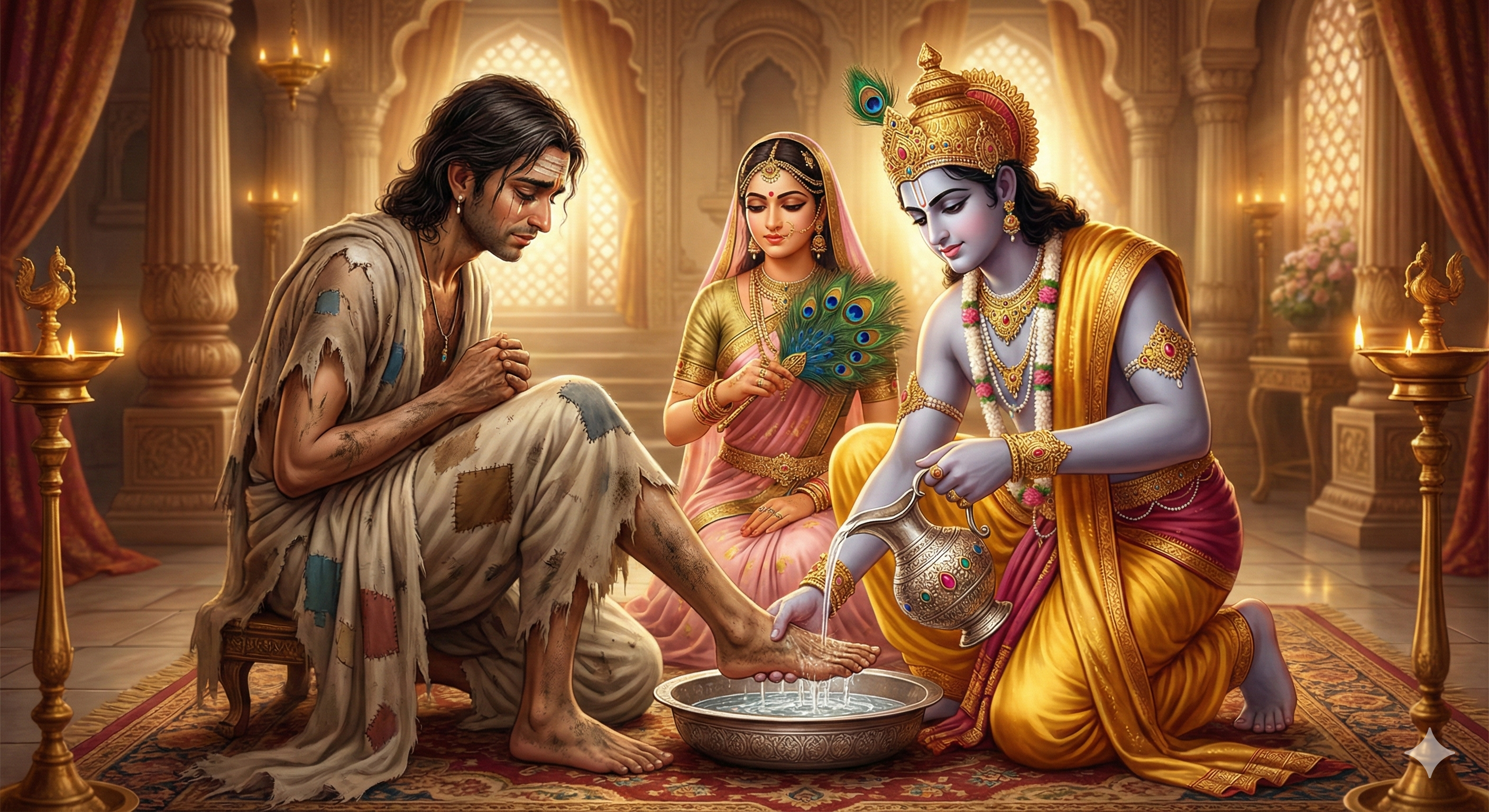
Krishna and Sudama
Sudama, a poor Brahmin and childhood friend of Krishna, visited Dwarka to ask for help but felt too ashamed to ask. He brought only a handful of beaten rice (poha) as a gift. Krishna, the King of Kings, ran barefoot to welcome his friend, washed his feet, and ate the humble rice with great joy! He didn't give Sudama wealth directly to preserve his dignity. However, when Sudama returned home, he found his hut transformed into a palace! Krishna showed that true friendship looks at the heart, not status.
Fun Fact
Krishna ate two handfuls of rice, giving Sudama two worlds of wealth; Rukmini stopped him from the third to save their own abode!
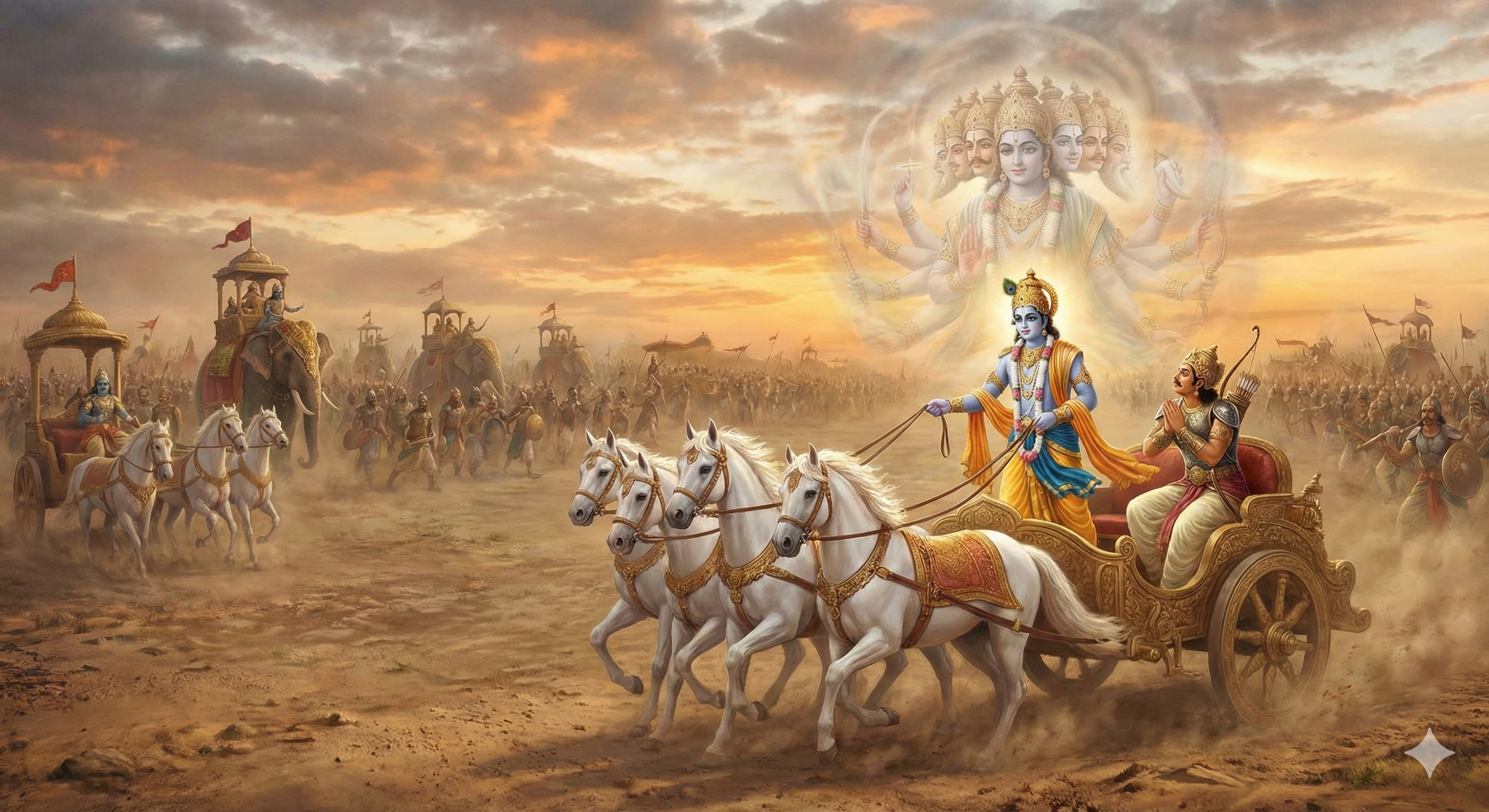
Krishna as a Guide (Gita)
In the great war of Mahabharata, Krishna chose not to fight but to be the charioteer of Arjuna. When Arjuna was confused and refused to fight his own family, Krishna stopped time and delivered the 'Bhagavad Gita' - the Song of God. He revealed the ultimate truth about life, duty (Karma), soul (Atma), and devotion (Bhakti). He showed his colossal Universal Form (Vishwaroop) to Arjuna, proving he is the source of everything. Krishna guided the Pandavas to victory through righteousness.
Fun Fact
The Bhagavad Gita is considered the manual of life, answering every human dilemma through 700 verses.
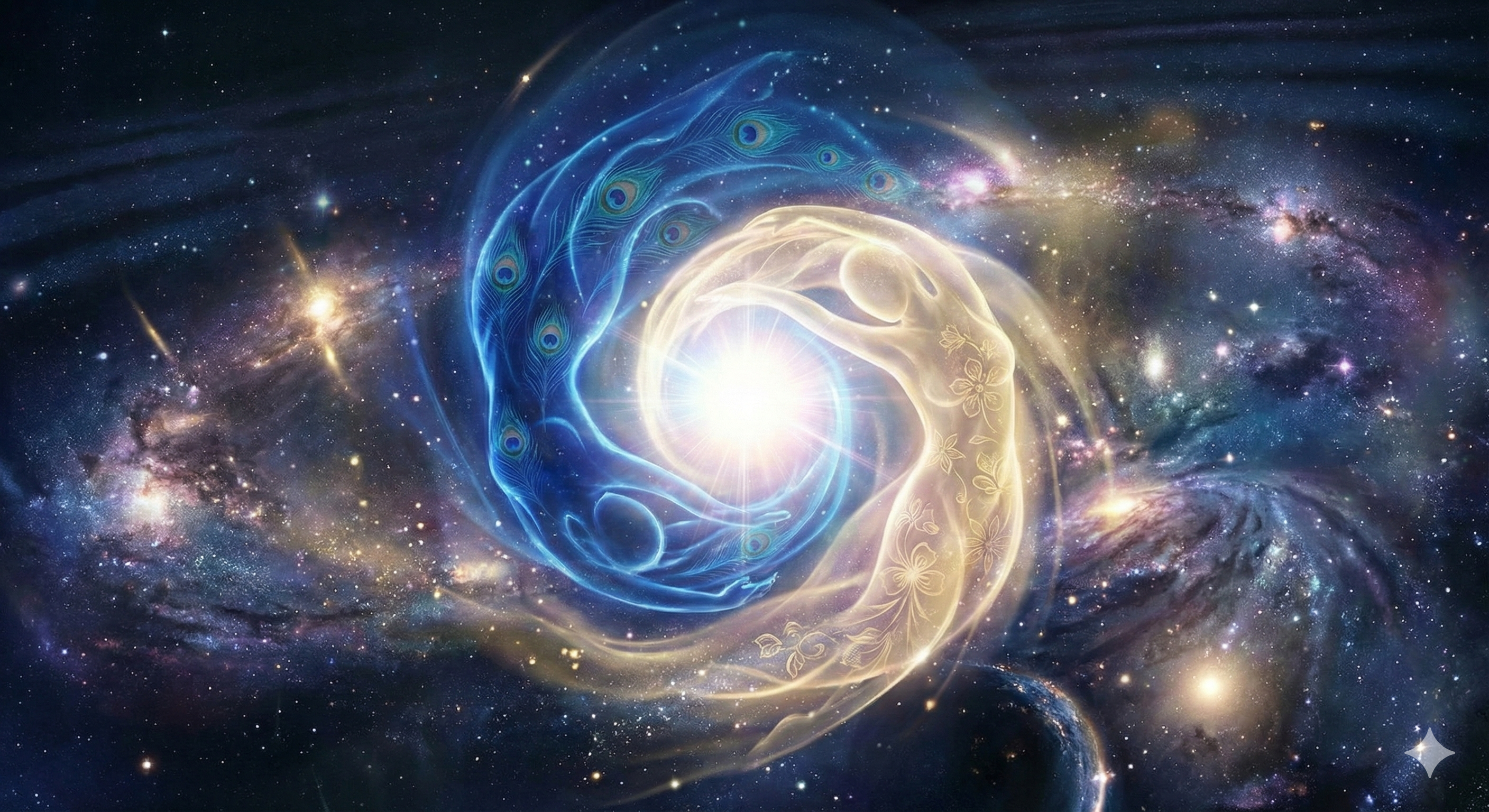
Radha Krishna’s Spiritual Love
The love story of Radha and Krishna is not a romantic tale of a man and a woman, but the divine interplay of the 'Paramatma' (Supreme Soul) and 'Jivatma' (Individual Soul). Radha is the embodied love of Krishna himself. They are one entity manifested as two to taste the sweetness of love. Their separation teaches that true love is not about possession but about constant remembrance and surrender. In every temple, Radha is worshiped first because she holds the key to Krishna's heart.
Fun Fact
Their names are never uttered separately; it is always 'Radha-Krishna', symbolizing their inseparable eternal union.
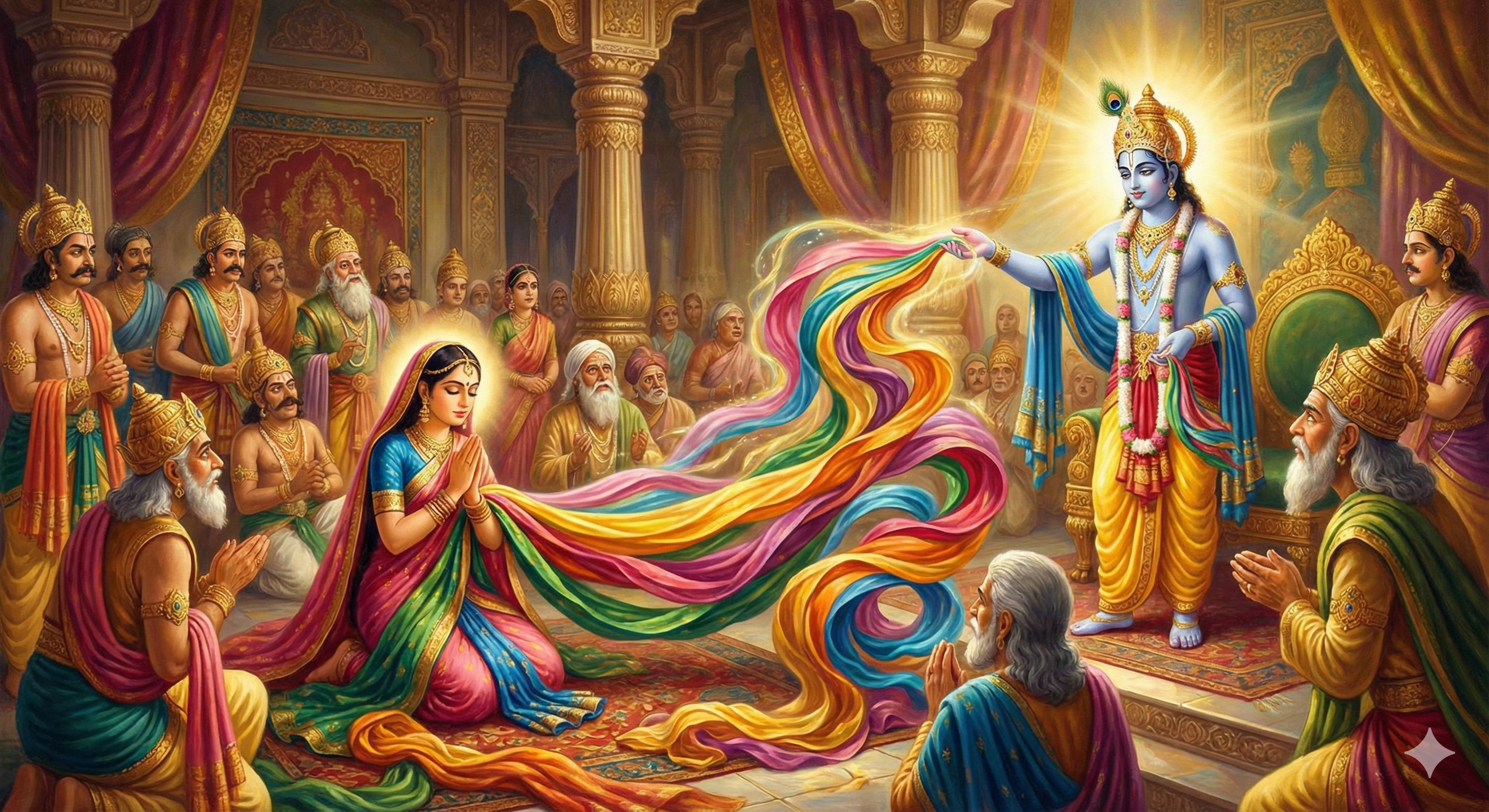
Krishna the Protector
Throughout his life, Krishna was the protector of the righteous. He saved Draupadi from humiliation in the Kaurava court by providing endless cloth (sari) when she prayed to him. He protected the Pandavas from numerous assassination attempts. He liberated 16,100 women held captive by the demon Narakasura and gave them social status by accepting them. Whoever surrendered to him, whether a sinner or a saint, found immediate refuge under his protection.
Fun Fact
His promise in the Gita 'Maamekam Sharanam Vraja' (Surrender to Me alone, I shall deliver you from all sins) is the ultimate assurance to humanity.

The Eternal Bond in Goloka
Beyond this material world lies the spiritual realm of Goloka Vrindavan, where Radha and Krishna reside eternally. There is no separation there, no time, and no sorrow. They engage in eternal pastimes (Nitya Leela) surrounded by Gopis and Gopas. The earthly stories are just a reflection of that eternal reality. Devotees aspire not for liberation, but to reach this abode to serve the divine couple lovingly forever.
Fun Fact
Goloka is described as shaped like a thousand-petaled lotus, with Radha and Krishna seated in the center.

Symbol of Divine Union
Radha and Krishna symbolize the perfect balance of masculine and feminine energies in the universe (Purusha and Prakriti). Krishna is the energetic, and Radha is the energy. Krishna is the enjoyer, and Radha is the enjoyment. One cannot exist without the other like fire and heat, or sun and sunlight. Together, they represent the wholeness of divinity. Worshiping them together brings harmony, love, and balance to a devotee's life.
Fun Fact
The word 'Radha' acts as a 'Dhara' (flow) of devotion towards the feet of Krishna.

Legacy of Divine Love
The legacy of Radha and Krishna continues to inspire millions through art, music, dance, and poetry. Festivals like Holi (celebrating their playful colors), Janmashtami, and Radhashtami keep their stories alive. Saints like Chaitanya Mahaprabhu propagated the chanting of the Hare Krishna mantra to awaken this divine love in every heart. Their story teaches us that God is not a distant judge, but a loving friend, child, and beloved wating for us to return home.
Fun Fact
The Hare Krishna Maha Mantra is composed almost entirely of the names of the divine couple: 'Hare' addresses Radha, and 'Krishna' and 'Rama' address the Lord.
"राधे राधे"
Where there is Love, there is Life